
Sell, track & manage tires and batteries at scale
From warehouse stock levels to point-of-sale fulfillment, Wizard Cloud ERP helps tire and battery distributors operate more efficiently with real-time inventory, automated sales processes, and customer service tracking.
Updated August 2026
Track by size & specs
Monitor tire sizes, batch numbers, and battery models across locations.
Sell faster, smarter
Generate quotes, manage credit terms, and close sales from desktop or mobile.
| Warehouse | Units | Value | Status |
|---|---|---|---|
| Beirut · Main | 3,940 | $512,400 | Healthy |
| Zalka · Overflow | 2,180 | $298,600 | Healthy |
| Tripoli · Branch | 1,412 | $204,900 | Low on 6 SKUs |
| Dubai · Transit | 880 | $124,700 | In transit |
| Customer | Value | Margin | Status |
|---|---|---|---|
| Al Mandaloun Group | $42,800 | 22.4% | Sent |
| Choucair Group | $18,200 | 19.1% | Discount approval |
| K-Lynn | $9,640 | 27.8% | Accepted |
| M. Nassif & Fils | $31,500 | 16.2% | Sent |
ERP built for tire and battery distributors
Sell to workshops, retailers, or end clients with a system designed to simplify stock tracking, pricing, and delivery, all from a single platform.
- Low
Cable 2.5mm · 100m
12 left, min 50
- Low
Battery 12V 70Ah
8 left, min 40
- Watch
Filter cartridge
31 left, min 30
Simplify operations with purpose-built features
Wizard helps you handle large product catalogs, track technical specs, and manage B2B sales with ease.
 Inventory by size, brand & type
 Price list by client type
 Batch & serial tracking
 Order to invoice in one click
From warehouse to workshop in 3 steps
Wizard helps you fulfill more orders, faster, with fewer errors.
- 01
Create & price orders
Select tires or batteries by type, brand, or dimensions, and auto-apply discounts.
- 02
Manage inventory movement
Track availability in real time, and organize stock by warehouse and shelf.
- 03
Deliver & invoice
Generate invoices, assign to drivers or trips, and close deliveries on-site.
Features designed for your business
Powerful, industry-specific features to help you grow faster and serve better.

Multi-criteria product catalog
Filter tires and batteries by size, voltage, brand, or SKU.

B2B sales management
Assign price lists, payment terms, and credit limits by customer group.

Mobile sales & delivery
Let sales reps or drivers generate orders and close deliveries via mobile.

Stock aging & rotation
Track product aging to rotate and discount older stock before expiry.
Modules that power tire & battery sales
Everything you need to manage pricing, delivery, stock, and sales performance.

Inventory
Track tires and batteries by size, brand, and stock level.

Sales
Convert quotations into orders or invoices, manage consignment, automate discounts, and track sales performance with ease.

Mobile sales app
Let reps and drivers create orders and close deliveries on the go.

Warehouse management
Organize stock and speed up picking, packing, and dispatch.
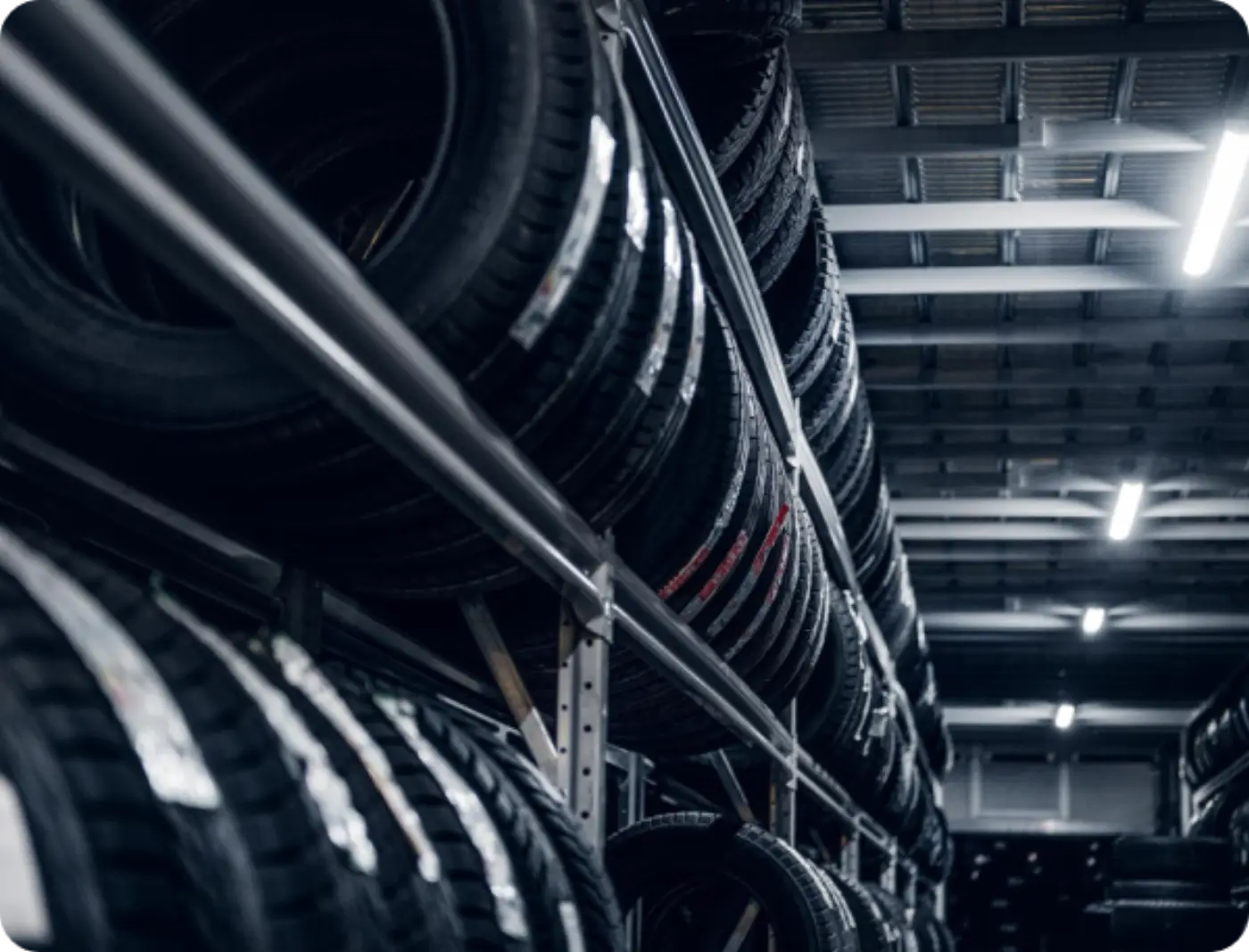
Hundreds of sizes and specs, and a customer waiting at the counter.
A customer asks for a size on the phone. How fast can we answer?
Size, brand, load and speed rating, battery capacity and polarity are held as attributes of the product rather than buried in its name. Staff filter to the exact specification and see the quantity in each branch, so the answer takes seconds and does not depend on who picked up the phone.
Tire and battery businesses carry catalogues that break most systems. A few hundred sizes, several brands per size, and a naming convention that varies depending on which supplier's list it was copied from. When the item file is a long list of similar text strings, finding stock becomes a skill rather than a task.
The cost of that is quiet. A caller wants 265/65 R17, the counter says no, and the branch across town has fourteen of them. Nobody records the lost sale, so it never appears in any report, and the same thing happens the next day.
Holding specifications as real fields also cleans up the reporting. You can look at what sold by rim size or by battery capacity instead of by product name, which is the only way to see what your market actually buys.
How do we settle a warranty claim on a battery sold nine months ago?
Serial numbers link the unit to the invoice it left on, so the sale date, the customer and the supplier batch are all on the record. Most claims are then a lookup rather than an argument, and you have what you need to claim back from the supplier instead of absorbing the cost.
The claim itself is rarely the expensive part. What costs money is the second half nobody tracks: the credit you gave the customer, the unit you sent back to the supplier, and whether the supplier ever credited you for it.
When the serial carries its own history, that loop can be closed. You can see which units went out under which batch, how many came back, and which supplier claims are still open. A batch with an unusual failure rate becomes visible early rather than after you have replaced fifty of them.
Serial tracking only pays off if the number is captured at the point of sale. A workshop counter under pressure will skip it, and every skipped serial is a claim you will end up settling on trust later.
What do we do about tires that have been in the warehouse for two years?
Stock ageing is tracked per item and per location, so slow-moving units can be identified while they are still worth discounting. In this trade age matters commercially even when the product is undamaged, because buyers check date codes and the value of old stock only goes one way.
Capital tied up in dead sizes is the most common financial problem in tire distribution. It rarely shows in the accounts as a loss, because the stock is still valued at cost right up to the day someone finally admits it will not sell.
Ageing reports change the timing of that decision. A size that has not moved in six months is a promotion. The same size after two years is a write-down. The difference between those two outcomes is entirely a matter of when somebody looked.
This works alongside rotation rather than replacing it. Older units should leave first, which is a warehouse discipline, and the report is what tells you when the discipline is not holding.
| How long it has sat | What it usually means | Realistic action |
|---|---|---|
| Under three months | Normal stock cover on a moving size | Leave it alone |
| Three to six months | Ordered on optimism, or a size the market shifted away from | Push it to the branch that sells it |
| Six to twelve months | Working capital sitting still | Discount while it is still current stock |
| Over twelve months | Buyers will check the date code | Clear it, and stop reordering the size |
| Never sold in any branch | A buying decision that did not work | Write down and record why, so it is not repeated |
Why does the same workshop get a different price from every branch?
Because pricing lives in people's heads. Price lists assigned by customer group fix that: a workshop, a retailer and a fleet each buy on their own terms, applied automatically wherever the order is taken. Discounts beyond the list are recorded against whoever gave them.
In a B2B tire and battery business the price is the relationship, and that is exactly why it drifts. A regular workshop negotiates with one branch, mentions it at another, and within a year the same customer has three prices depending on who serves them.
Credit works the same way. Terms and limits belong to the customer rather than to the branch, so a workshop that is behind on payment does not simply drive twenty minutes to a colleague who has not heard about it.
The system will not make the commercial decision for you. Someone still has to decide what a fleet deserves against a small garage, and whether the volume being bought justifies it. What changes is that the decision is written down once instead of renegotiated at every counter.
How should we handle stock placed with workshops on consignment?
Consigned units are still yours until they are sold, and they need to be tracked that way. Held as stock at the workshop's location rather than written off your books, they stay visible, get counted, and turn into a sale and a receivable only when the workshop reports them.
Consignment is normal in this trade and it is where a lot of stock quietly disappears. Units sit at fifteen workshops, each holding a slightly different quantity than anyone believes, and reconciliation happens once a year if at all.
Keeping consigned stock in the inventory records at least makes the exposure countable. You can see how much value is sitting outside your own walls, which workshops hold the most, and how long it has been there.
Be realistic about what this does and does not solve. It gives you a number to check against, but somebody still has to go and count.
Stock by location, including customer sites
Consigned units stay in your inventory rather than in a side spreadsheet.
Sale recorded when the workshop reports
Revenue, cost and the receivable post together at that point.
Ageing on consigned units too
Stock parked at a workshop for a year is still stock parked for a year.
One customer record
What they hold, what they owe and what they bought, on the same account.
What should we get right before ordering the next container?
Sales history by size and by branch, current stock and its age, and what is already on order. Reorder levels per item and per location flag shortages, and purchase orders can be raised from them, but the buying judgement stays with the person who knows the market.
Ordering in this business is done in containers, months ahead, against a season that has not happened yet. Getting it wrong in one direction means empty shelves in the busiest weeks. Getting it wrong in the other means capital sitting in a warehouse until the date codes embarrass you.
History by size is the honest input. Not what sold overall, but what sold in each branch, in which months, and at what margin after discount. That is usually available in a distributor's records and almost never assembled, because pulling it together by hand takes a week.
No ERP forecasts your season. What it can do is put last year's numbers, current stock, open purchase orders and supplier lead times in front of the buyer at the same time, which is more than most tire distributors have when they place the order.
Trusted by businesses across Lebanon and the Gulf





Businesses already running on Wizard
Wizard Cloud ERP completely streamlined our operations, online and in-store. From inventory syncing to order fulfillment, everything now runs smoother, faster, and with fewer errors.
AghasarkissianRetail, online and in-storeManaging multiple restaurants under one group was a challenge, until Wizard Cloud ERP stepped in. We now have better visibility, centralized control, and smoother day-to-day operations across every concept.
Al Mandaloun GroupHospitality, multi-outletWizard Cloud ERP brought structure and clarity to our luxury business. From sales tracking to customer experience, we now operate with precision while maintaining our premium standards.
Choucair GroupLuxury retailWizard Cloud ERP gave us full control over our multi-branch retail operations. We can manage inventory, sales, and customer data seamlessly, all from one platform.
K-LynnMulti-branch retailAs exclusive brand distributors, we needed visibility and flexibility. Wizard Cloud ERP helps us track every shipment, order, and partner account with confidence.
M. Nassif & FilsExclusive brand distributionHandling installations, service, and logistics at scale used to be complicated. With Wizard Cloud ERP, we now track every detail across departments; streamlined, connected, and always up to date.
OTISInstallation and field service
Questions we get asked
If yours is not here, ask on the demo call. We would rather tell you it is not a fit than sell you the wrong thing.
Ask us directlySee it running on your own numbers
Bring one messy process, the one that eats your week, and we will show you what it looks like inside Wizard. If it is not a fit, we will say so.
- Thirty minutes, and you can bring your finance person
- We look at the tools you run today before we show you anything
- Nothing to sign and no card needed
- 1You tell us what is breakingA short form: your sector, rough size, and the process that hurts most.
- 2We come back within one working dayWith whether we are a fit, and which modules would actually apply.
- 3A demo built around your caseNot a generic tour. Your workflow, your kind of data.