
 Operations
Optimize your production workflow
Plan, track, and manage your entire production process with Wizard Cloud ERP’s Production Module. Improve efficiency, reduce waste, and keep manufacturing with real-time tracking and automation.
Updated August 2026
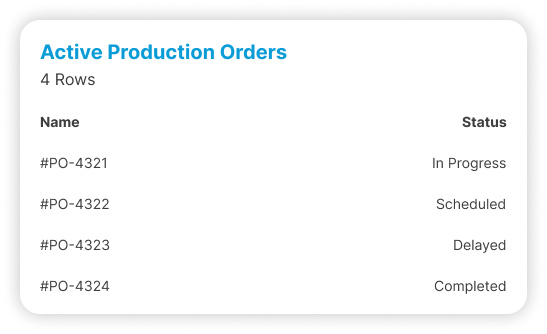
- WO-1182 · Batch A92% complete
- WO-1183 · Batch B64% complete
- WO-1184 · Batch Cmaterial short
- WO-1185 · Batch D12% complete
Simplify manufacturing & reduce costs

Production planning & scheduling
Optimize workflows with real-time tracking of raw materials, production stages, and order fulfillment.

Cost & waste reduction
Monitor resource usage, reduce production waste, and calculate costs with precision.
| Component | Required | Status |
|---|---|---|
| Resin pellets | 1,200 kg | In stock |
| Steel bracket | 3,400 pcs | In stock |
| Label roll | 180 rolls | Short 40 |
Increase efficiency & reduce delays
Improve manufacturing productivity with automated tracking, cost control, and connected order management.
Powerful features for smarter manufacturing
Automate production planning, material tracking, and workflow optimization with ease.

Raw material procurement
Track and manage raw material availability and procurement requests.

Cost tracking & budgeting
Monitor direct expenses, overhead costs, and raw material consumption.

Batch & order management
Plan and schedule production batches to meet demand and reduce delays.

Quality control & compliance
Ensure high-quality production with automated inspection and reporting.

What the batch actually cost, not what it was supposed to.
Who runs Production
The sectors where this one does the most work. Each has its own page.



Why do production plans fall apart in the first week?
Usually because the plan was built somewhere the materials are not. A schedule made in a spreadsheet assumes stock that has already been committed to another order. When planning reads live stock and open purchase orders, a shortage appears while there is still time to buy or reschedule.
Ask a production manager what went wrong last month and the answer is rarely the machines. It is a component that arrived late, a batch held back after inspection, or an order that was promised a date nobody checked against what the line could do.
Planning against real stock does not remove supplier delays. It moves the discovery of the problem from the shop floor to the office, a week earlier, where somebody can still call the supplier, split the run or tell the customer before the customer calls first.
Where does the real cost of a production run hide?
In the parts nobody counts. Material consumed above the recipe, rework, and overheads spread evenly instead of landing where they were incurred. Recording consumption and costs against each production order turns a standard cost into what the run actually cost, and the gap between the two is the number worth watching.
Standard costs age badly. A recipe costed two years ago against a supplier price that has moved twice since will still produce a tidy figure, and the figure will be wrong in the direction that hurts.
The honest caveat: you only get this level of detail if the floor records consumption as it happens. A company that issues materials in bulk on Monday and reconciles on Friday will get run costs that are roughly right, which beats nothing and is not the same as accurate.
| Cost element | Common treatment | What a production order records |
|---|---|---|
| Raw material | The standard recipe quantity | What was actually issued to that order |
| Waste and offcuts | Absorbed into general stock loss | The difference between what went in and what came out |
| Rework | Rarely recorded at all | A second consumption against the same order |
| Direct expenses | A monthly total for the whole factory | Booked against the order that incurred them |
| Overhead | Spread evenly across output | Allocated to the runs that carried it |
| Finished goods cost | An estimate carried for years | Built from what the run consumed |
What does quality control look like inside the system?
Inspection becomes a recorded step rather than a signature on a sheet. A batch is checked, the result is stored against the production order, and what passed or failed stays attached to the finished goods. When a customer complains six months later, the batch record is the answer.
Traceability is the practical value. Because inventory tracks lots and serial numbers, a finished batch can be traced back to the raw material batches that went into it and forward to the customers who received it.
For food, beverage and pharmaceutical production that is a compliance requirement. For everyone else it is the difference between recalling one batch and recalling three months of output because nothing on the shelf can be told apart.
Who has to enter what on the shop floor?
Less than people expect, and not nothing. Somebody has to record materials issued to a run, output produced, and stages completed. That is three entries, not a form. Rollouts usually fail because a company tries to capture every small step in the first month and the floor stops cooperating.
Start with the entries that change a number somebody uses. Material issued changes stock and cost. Output changes finished goods. A stage completed changes what the office can promise a customer. The rest can wait until those three are habits.
Where the entry happens matters as much as what is entered. A terminal near the line gets used. A paper form that has to be carried to the office at the end of a shift gets filled in from memory, and memory rounds numbers to whatever sounds reasonable.
How does a customer order become a production order?
The sales order sets the requirement, the production order plans the run, and the materials it needs are checked against stock. Anything short can go to procurement as a purchase request. Finished goods land back in inventory, ready to be delivered against the order that started the whole thing.
This chain is why manufacturers move to an ERP rather than to a production tool. The production step on its own is not the hard part. The hand-offs are, and hand-offs are where the promised dates get lost.
It also changes what sales can commit to. A rep who can see planned output and what is already committed gives a delivery date he can defend, instead of a hopeful one that the factory hears about later.
Why does the factory number never match the finance number?
Because they come from different sources. The floor counts units, finance values them from a costing sheet updated on its own schedule. When production consumption posts to the ledger as it happens, work in progress, finished goods and cost of sales all come from the records the factory is already working in.
The month-end argument is rarely a real disagreement. It burns days every period while somebody rebuilds the bridge between two versions of the same output, and it is usually settled by whoever has more patience rather than by whoever is right.
Budget against actual is the useful output. Once each order carries both its planned cost and its real one, variance is visible per run instead of arriving as a single factory-wide number that hides the two products quietly losing money.
Connected to the rest of the system
The Production Module connects with other key business functions for a complete manufacturing solution.

Inventory
One stock position across every warehouse and branch, updated as goods actually move.

Procurement
Raise purchase orders, see what you last paid, and route approvals without an email chain.

Accounting
Post entries automatically, reconcile the bank, and close the month without rebuilding it in Excel.

Warehouse Management
Bins, zones and barcode picking, so the wrong item cannot leave the building.
Trusted by businesses across Lebanon and the Gulf





Businesses already running on Wizard
Wizard Cloud ERP completely streamlined our operations, online and in-store. From inventory syncing to order fulfillment, everything now runs smoother, faster, and with fewer errors.
AghasarkissianRetail, online and in-storeManaging multiple restaurants under one group was a challenge, until Wizard Cloud ERP stepped in. We now have better visibility, centralized control, and smoother day-to-day operations across every concept.
Al Mandaloun GroupHospitality, multi-outletWizard Cloud ERP brought structure and clarity to our luxury business. From sales tracking to customer experience, we now operate with precision while maintaining our premium standards.
Choucair GroupLuxury retailWizard Cloud ERP gave us full control over our multi-branch retail operations. We can manage inventory, sales, and customer data seamlessly, all from one platform.
K-LynnMulti-branch retailAs exclusive brand distributors, we needed visibility and flexibility. Wizard Cloud ERP helps us track every shipment, order, and partner account with confidence.
M. Nassif & FilsExclusive brand distributionHandling installations, service, and logistics at scale used to be complicated. With Wizard Cloud ERP, we now track every detail across departments; streamlined, connected, and always up to date.
OTISInstallation and field service
Questions we get asked
If yours is not here, ask on the demo call. We would rather tell you it is not a fit than sell you the wrong thing.
Ask us directlySee it running on your own numbers
Bring one messy process, the one that eats your week, and we will show you what it looks like inside Wizard. If it is not a fit, we will say so.
- Thirty minutes, and you can bring your finance person
- We look at the tools you run today before we show you anything
- Nothing to sign and no card needed
- 1You tell us what is breakingA short form: your sector, rough size, and the process that hurts most.
- 2We come back within one working dayWith whether we are a fit, and which modules would actually apply.
- 3A demo built around your caseNot a generic tour. Your workflow, your kind of data.